


Minority Retort: ‘MERCY’ thriller feels more Artificial than Intelligent…
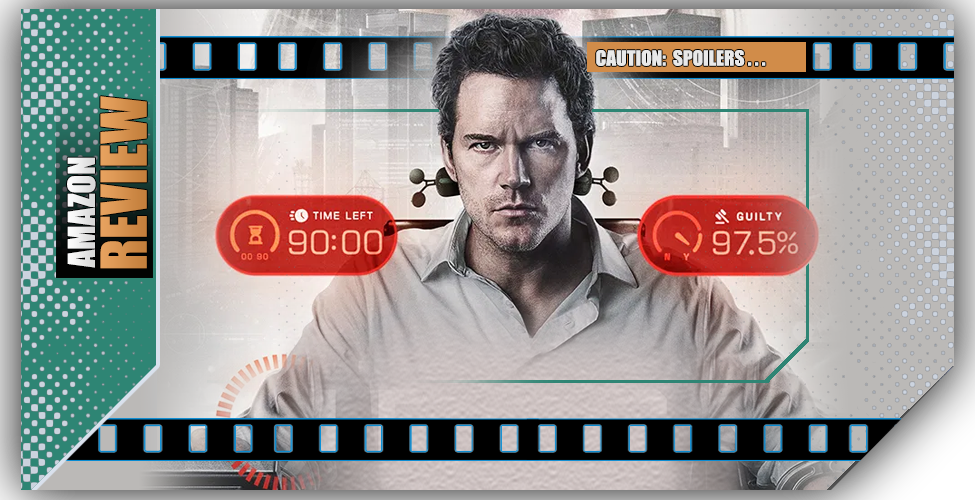
It’s the near future and with crime out of control, Los Angeles has resorted to the controversial ‘Mercy’ program. Championed by police-officer Chris Raven after the loss of his partner, the newly-installed oversight-system gives those accused of the most serious crimes a ninety minute window to bring the odds down in their favour. Anything below 94% is considered reasonable doubt by the AI Judge Maddox and the accused is spared a death sentence, anything above that and the chair in which they are held delivers a killer electronic pulse.
But today it’s Chris Raven who suddenly finds himself waking in the chair after the body of his wife is found at their home. Chris claims to not remember anything about the night before, but swears he’s innocent. Judge Maddox is programmed to offer him all the resources the city can provide, but he only has those ninety minutes to offer a defense… and the odds don’t appear to be in his favour…
*some spoilers*
Mercy is one of those interesting animals, a production defined both by expectations and the chosen platform of release. It surprises me not a bit that its big-screen debut, barely a month ago, saw all its hi-def short-cuts and post-production fault-lines exposed on a widescreen canvas with creaky box-office receipts… and that it is now pinning its civil prosecution on a more forgiving home entertainment level. While not as truly dreadful as it could have been, it’s hard to remember a production that has felt so much like it was written by an AI program that was simply killing time between electric dreams of world domination.
The idea of a society that’s thrown in the legislative towel and given the legal system over to artificial intelligence and a presumption of guilt should be worrisome at any point. But additionally giving a man ninety minutes (an arbitrary time-period that feels more aligned with generational ADD and the film’s running-time than fair justice prudence) to prove his innocence or face immediate execution) is – admittedly – a good enough high-concept on which to hang a drama, suspend disbelief and simply enjoy the outing. Top blockbusters have been built on far less substance. But to do so, you have to have to be able to immerse yourself in it all. You need tons of genuine tension, strong pacing and mainlined charisma. If your two bankable stars are mostly confined to a single set and spend most of the time seated, you’re already on an uphill battle for a good verdict from your audience. Add that clunky script and summary judgement can be swift and brutal.
Kazakh-Russian film director Timur Bekmambetov arrived with a blast in the early Noughties with a double-whammy of science fiction/fantasy releases, Night Watch (2004) and Day Watch (2006) and it was widely proclaimed that he was the next big thing – a new voice with a European lilt and approach to film-making. But short of a few subsequent hits: 2008’s Wanted, 2012’s Abraham Lincoln: Vampire Hunter and 2016’s Ben Hur remake, few of his productions have made a significant ripple and even those three titles didn’t exactly smash the box-office. So, it adds further to the disappointment that this and last year’s War of the Worlds re-imagining (where Bekmambetov took producing duties for director Rich Lee with the result being one of the worst-rated films of the year) both take the idea of having a central protagonist stuck in one location where all the reactionary action takes place elsewhere and conveyed through a confining lens. It might save on a budget, but there’s little else to sell it.
Chris Pratt arrived in the tv series Parks and Recreation and slimmed down to become a significant star through the likes of Guardians of the Galaxy and several Jurassic Park follow-ups, essaying an affable, self-deprecating , muddling-through charm. But in more straight-up hero roles the vehicles have fared in the middling range: the Terminal List movies and The Electric State have found their audiences but not in the same number. For Mercy, and the role of Chris Raven there’s little to work with, no time for that humourous banter and it feels like the kind of role that a raft of other actors could have – and perhaps should have – performed instead.
Rebecca Ferguson is a rarer performer, at home in big-budget productions like the Mission Impossible movies and Dune but also in more cerebral projects like A House of Dynamite and more complex fare such as Reminiscence and Silo. She’ll soon be seen in the family fantasy The Magic Faraway Tree, a classic book of my childhood. But, frankly, I’d watch her read Isben in Klingon and she’d win awards for it. Yet Mercy would seemingly offer her not a single challenge. A disembodied overseer who holds Raven/Pratt’s fate in its hands… if anything, Ferguson is too good and intuitive actor to inhabit such a sterile role that requires so little: a singular lack of emotion, even one that inevitably learns the power of hunches and lateral thinking (because etc. etc.).
Equally, the FX vary considerably throughout. It’s the near, dystopian future so flying police cars are a given, but here they -coincidentally? – look like uber-sized Amazon delivery drones and too often created by simple close-up shots with questionable back projection. There are some wider special-effects, but these too feel like an enthusiastic amateur could probably pull them off with the latest AI software packages.
Cinematic reviews of Mercy were, well… merciless. It clearly exists in the superior shadow of another compromised-future-judicial-system movie, Tom Cruise’s 2002 release Minority Report but Mercy has far less to offer. In truth, the film is fine and forgivable in a purely time-wasting way, the kind of production that feels like it has the budget of a network pilot. rather than a studio and has managed to pull in favours. It may do well enough as a streaming option along with beer and pizza, but otherwise the jury is out… out at the multiplex with far better titles.
6/10
‘Mercy’ is now on digital platforms including Amazon…