

Death Becomes Her: WE BURY THE DEAD’s Practical Post-Apocalypse…
Nowadays you can’t throw a rock, fire a crossbow or wield a spikey baseball bat without hitting some type of zombie project. The Walking Dead may have wandered off over the horizon, but there’s still been the likes of The Last of Us, 28 Years Later and Daryl Dixon.
The tempting question is whether there’s anything new to offer about the circulatory-challenged.
We Bury the Dead presents the aftermath of an accidental deployment of a new American bomb that sends out a biological EMP pulse ending life through most of Tasmania, South Australia. Most victims dropped dead in the middle of whatever task or place they were situated, but a small percentage remain somehow aware – a kind of shuffling dead working on a simple instinctual level. There’s obviously political fallout to the huge event, but here, we’re more concerned with the practical clear-up.
It’s the tone of We Bury the Dead that sets it just a little part from its undead stable-mates. The Lord of the Rings aside, Antipodean cinema has often seen film-makers eschewing big Hollywood set-pieces and, instead, focusing on quirky diamonds in the rough. There’s something in the signature of both Australian and New Zealand film-making that deliberately weaponises the mundane – dramatic situations experienced through the eyes of an average ‘bloke’ or ‘Sheila’. Sometimes the offerings are hilariously off-beat, sometimes it’s all savagely dark – sometimes a bit of both. We Bury the Dead is of the darker hue with less to smile about but its moments of actual violence are limited – it’s ultimately more a tale about the sheer weight of sadness and loss in the aftermath of tragedy. Here the ‘undead’ may be random victims somehow clinging to the last bit of life in a primal motor-functioned way, but instead of manic pursuits and wild gnashings of teeth by generically decaying hordes, the film emphasises the populace’s feelings of loss, tragedy and abandonment – the seemingly random golem-like figures were all someone’s loved one and now only a shell, like a physical manifestation of an all-encompassing Alzheimer’s, remains as the pragmatic ‘clean-up’ begins.
The film emphasises the populace’s feelings of loss, tragedy and abandonment – the seemingly random golem-like figures were all someone’s loved one and now only a shell, like a physical manifestation of an all-encompassing Alzheimer’s…
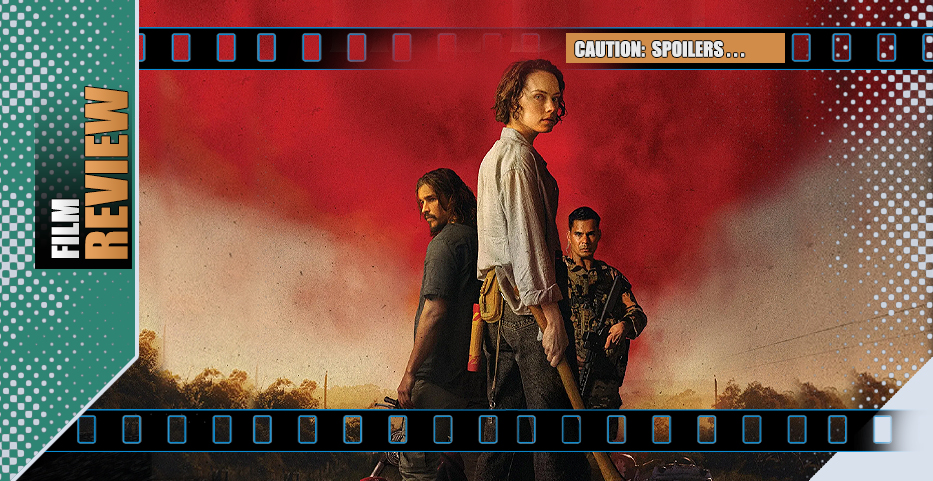
Daisy Ridley is a good actor but after her central role as Rey in the final Star Wars trilogy, some of her films have struggled to give her a good vehicle. Here her character, Ava, joins a FEMA-like clean-up, the sadly pragmatic duty of finding the dead and removing their bodies to be disposed of in mass graves. But she’s really there for some sort of closure, a way to get closer to a physical and emotional destination beyond her duties. Her husband Mitch (Matt Whelan) was away at a resort two hundred miles further south and she feels an innate need to know what happened to him. Did he die in the original pulse or is he one of the ‘undead’, whom she starts to believe may still retain more than the official line suggests. Which fate would be better?
Brenton Thwaites (Oculus, Maleficent) is the stubbly, tousled rebel Clay who agrees to help Ava in her search, but for a long while it’s hard to find anything but opportunistic lack of depth. He has his token backstory including the loss of loved ones, but it feels like a very generic role which could have been expanded. Mark Coles Smith (Beast of War, Savage River) is Riley, a soldier in the clearance zone that the two travellers encounter and whose initial help holds a more gruesome secret.
Ridley plays Ava with a blind, bittersweet mixture of love and anger but though it gives her time to look mournfully and forcefully to the next horizon and slowly reveal flashbacks of her domestic life (perhaps not as perfect as we first think), it sometimes feels like director Zak Hilditch (whose other apocalyptic work includes These Final Hours and the short Transmission and also the atmospheric frontier-story 1922) has again gone for a vibe more than a full story. In truth, you’ll be one step ahead through most of the journey and there are few surprises here. Anyone looking for an ‘action’ movie has definitely come to the wrong place. Many of the story beats are well-signaled, well-used tropes. There’s the supposedly deserted structures that sometimes hold more than they appear, a cop that screams ‘crazy’ from his first quiet moments on screen and collateral casualties along the way. It’s not damning – the performances help raise the experience and there’s worse fates than playing to familiar set-ups. For the purists, there’s a couple of volatile sequences (one involving the human revenants and another more conventional human violence) but the pacing is meandering at best. Grief, we know, rarely confines itself to a timetable.
We are treated to a travelogue of changing landscapes and there’s no denying the beauty of nature at odds with the impact of crimson-skied, flaming pits of cadavers as a backdrop to the human devastation. Suburban areas are mostly run down but intact, though we don’t need a scratch-n-sniff to know the stench of decay is likely overwhelming. If the story itself is limited, Hilditch does create a sense of isolation, a veneer of normality with cracks already showing and that keeps you watching.
The release notes suggest a government conspiracy and that the undead are ‘growing more violent, more relentless, and more dangerous’ but that really doesn’t feel like the film as delivered. Worth watching, We Bury the Dead is still an interesting attempt to approach an apocalypse in a new and more deeply personal way, but frustratingly feels like 2/3 of a better and faster film, offering an effective slice of grief within a well-trod genre, but with a viewpoint that feels uneven and incomplete as if it’s not completely committing to either mainstream or arthouse. The difference between the journey and the destination don’t quite tally.
8/10
‘We Bury the Dead’ is now on Digital HD from Amazon Video and iTunes